


Coming Soon Page Design: Creative Inspiration for Your Next Big Reveal
- 24 minutes ago
- 8 min read
What Makes a Great Coming Soon Page Design (And Why It Matters Before Launch)

Coming soon page design is one of the most underestimated steps in launching a new business or product online. Most people treat it as a placeholder. The best ones use it as their first conversion event.
Here are the core elements of a high-converting coming soon page at a glance:
Benefit-driven headline — tell visitors what's in it for them, not just "we're launching soon"
Single email capture field — one field only; more fields kill conversions
Strong background visual — a photo, gradient, or brand color that sets the mood instantly
Clear CTA button — use action-oriented text like "Get Early Access" or "Join the Waitlist"
Countdown timer (optional) — only if you have a firm, locked-in launch date
Social media links — keep visitors connected across platforms while they wait
The difference between a forgettable holding screen and a page that builds a real audience comes down to intent. A well-designed pre-launch page can start collecting email signups, establish your brand identity, and even help search engines begin indexing your domain — all before you've opened your virtual doors.
One razor subscription startup collected 100,000 email signups in a single week using a pre-launch page with a referral loop, with 77% of those signups coming from referrals alone. That's what a strategic coming soon page can do.
I'm Athena Kavis, a web designer with over 8 years of experience and more than 1,000 websites designed — including dozens of coming soon page design projects for e-commerce brands, SaaS startups, and hospitality businesses on Wix and Shopify. Everything below is drawn from real-world experience building pages that actually convert before launch day.

Essential Elements of a High-Converting Coming Soon Page Design
Most coming soon pages fail because they ask visitors to trust that something interesting is on the horizon without giving them a compelling reason to care. When we design pre-launch pages for our clients, we focus heavily on conversion principles rather than static decorative graphics.
To turn passive interest into active email subscribers, your coming soon page design must balance visual clarity with strong direct-response mechanics. The highest-converting pages share a core set of elements working together in harmony:
A Clear, Benefit-Driven Headline: Avoid generic phrasing like "Under Construction." Instead, state the exact problem you solve or the unique value of your upcoming product.
Single-Field Lead Capture: Collecting only an email address drastically reduces friction. Industry research shows that reducing form fields from 11 down to 4 increases conversions by 120%, and on a pre-launch page, keeping it strictly to one field is the gold standard.
Action-Oriented Call to Action (CTA): Use persuasive text on your button. Changing standard CTA text to benefit-focused phrases like "Claim Early Access" or "Unlock VIP Discount" yields immediate lifts in conversions.
Visual Brand Teasers: High-quality product silhouettes, background videos, or mood imagery set expectations and establish brand trust immediately.
Social Proof & Scarcity Signals: Displaying total waitlist counts (e.g., "Join 2,400+ people on the waitlist") or limited beta spots leverages urgency naturally.

The layout friction you introduce directly impacts your conversion rate. Here is how single-field opt-in designs compare against traditional multi-field forms during a pre-launch phase:
Feature / Metric | Single-Field Opt-In Design | Multi-Field Lead Capture |
Primary Fields Required | Email address only | Name, Email, Job Title, Company |
Average Conversion Rate | 10% – 30% | 3% – 8% |
User Friction Level | Near zero cognitive load | High friction; causes drop-off |
Mobile Experience | Instant touch completion | Requires extensive typing |
Best Used For | Consumer waitlists, e-commerce teasers | B2B sales calls & detailed consultations |
To dive deeper into structuring layout mechanics for maximum conversion rates, check out our guide on Landing Page Design Tips 2026.
Distinct Coming Soon Page Design Styles and Aesthetic Trends
Choosing the visual personality of your pre-launch page depends entirely on your target audience and industry category. A sleek SaaS software platform calls for a very different layout than an artisan boutique or a luxury hotel in Las Vegas.
Current design trends rely on bold visual styles like dark mode, glassmorphism overlays, and strategic information rationing to hook attention. Let's look at the primary aesthetic approaches that dominate modern web design.
Minimalist and Bold Branding Coming Soon Page Design
Minimalism is far from boring when executed correctly. A clean aesthetic uses high-contrast typography, focused color palettes, and single focal points to make the brand name unforgettable. By removing extra navigational clutter, you force the user's attention straight to your opt-in box.

When building minimalist pre-launch pages on Wix, we often pair deep background colors—such as abyssal navy or charcoal—with vibrant accent buttons in signal cyan or neon lime. This contrast guides the eye straight to the primary action. If you're building a new site on Wix, review our breakdown of custom Wix Landing Page Design strategies to streamline your visual structure, or browse community visual boards like Coming Soon Website Design for aesthetic inspiration.
Interactive and Spec-First Coming Soon Page Design
For technical products, creative tools, and developer platforms, standard marketing promises often fall flat. Technical audiences like CTOs, developers, and power users respond much better to concrete specifications and functional UI teasers.
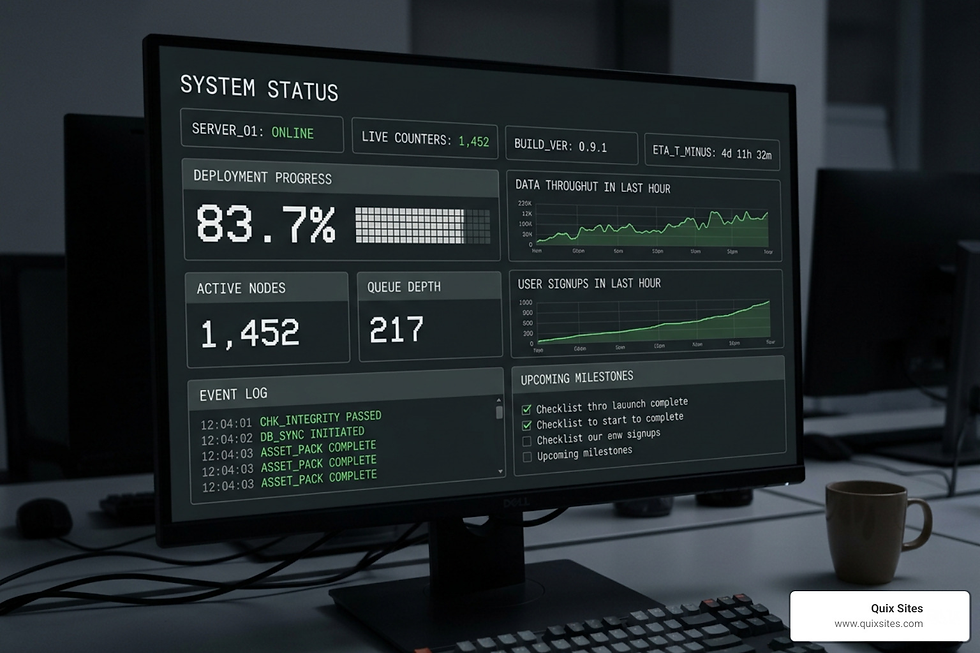
The spec-first trend uses dark brutalism, monospaced typography, and real-time interface widgets to signal technical rigor:
Live Scarcity Counters: A mechanical, dynamic counter displaying remaining beta spots creates real data-driven urgency.
Mid-Build Progress Indicators: Showing a 67% progress ring or a simulated development kanban board demonstrates real active momentum.
Information Rationing Tables: Scroll-triggered blurred cells that unlock details as users interact convert information retrieval into a reward mechanism.
A great example of this structured layout approach is the SaaS Coming Soon Website Template | Rocket, which pairs a 50/50 split-screen format with raw technical specifications to build instant credibility.
High-Converting Coming Soon Page Examples and Templates
Studying proven visual frameworks accelerates your launch timeline significantly. Whether you're teasing a digital application or opening a physical venue in Henderson or Centennial Hills, these template structures illustrate how storytelling creates pre-launch demand.
Animated Waitlist Teaser Pages
Sometimes, saying less creates more intrigue. Cryptic, narrative-driven teaser formats trade feature-heavy explanations for mystery, trusting that curiosity converts better than exhaustive descriptions.
A popular format is the 6-pane story sequence running roughly 18 to 24 seconds (at 3 seconds per frame), which fits social media video ad attention budgets perfectly:
Cover Pane: Atmospheric gradient or backlit silhouette displaying the project title.
Problem Statement: One concise sentence describing what is broken in the industry.
The Hint: A subtle visual teaser or product render without fully revealing the solution.
The Promise: A clear statement of the primary outcome the product delivers.
Launch Date: Firm date reveal set in clean, high-contrast typography.
Waitlist Sign-Up: The conversion screen featuring a single email input field and an exclusive early-bird incentive (e.g., "First 500 signups unlock founder pricing").
For teams looking to deploy this exact storytelling arc, the Coming Soon Template - Waitlist Teaser Page | PaneFlow provides a complete blueprint engineered for social launch campaigns and waitlist generation.
Niche Landing Teasers and Hotel Pre-Openings
Hospitality businesses, brick-and-mortar storefronts, and service providers require an immersive experience that brings the physical atmosphere online before opening day.
For boutique hotel developers soft-launching a venue, static placeholder graphics rarely build emotional investment. Instead, modern pre-opening pages incorporate interactive preview tools:
Touch-Friendly Room Carousels: Swipeable headers allowing visitors to view room renderings.
Instant Digital Rewards: Submitting an email instantly generates a custom access code unlocking a virtual tour or VIP reservation calendar.
Multi-Point CTA Architecture: Placing sign-up triggers in the hero section, within a sticky bar pinned at 40% scroll depth, and in the bottom section ensures maximum exposure.
To see how interactive elements elevate luxury pre-openings, explore the Hotel Coming Soon Website Template | Rocket or examine code blocks like the coming-soon-with-countdown-timer for rapid feature implementation.
If you want to skip building from scratch, you can also explore ready-to-use layouts in our online shop at Quix Sites Shop.
Pre-Launch SEO, Traffic, and List-Building Strategies
A major misconception about coming soon pages is that they are invisible to search engines. In reality, publishing a pre-launch page on your target domain is one of the best ways to kickstart your technical SEO strategy months before launch.
When you publish a coming soon page on a custom domain, search engine crawlers begin indexing your web address, evaluating page metadata, and building initial domain age authority.
Here is how to maximize your pre-launch SEO and list-building engine:
Establish Essential Metadata: Customize your meta title, H1 header, and meta description around your primary industry keywords so search engines categorize your site correctly from day one.
Acquire Early Backlinks: Use your coming soon page as the target URL for press releases, guest directory listings, and social profile links to build backlink authority early.
Build a Viral Referral Loop: Turn new email subscribers into active promoters. Offer incentives where users move up the waitlist or earn launch discounts by referring friends via a personalized link.
Leverage Secondary Channels: Include links to your social channels or direct contact options so prospective clients can reach out while the main platform is under construction.
To ensure your pre-launch page provides seamless navigation for both users and search bots, review our guide to Optimize Website User Experience.
Key Differences: Coming Soon vs. Under Construction vs. Maintenance Mode
Site owners frequently confuse pre-launch pages with temporary maintenance overlays. Using the wrong setup can cause search engines to de-index your site or leave visitors confused about your operational status.
Here is a breakdown of how these three temporary page configurations differ:
Coming Soon Page:
Purpose: Pre-launch marketing, brand building, and lead generation for a new brand or product.
HTTP Status Code: 200 OK (Signals to search engines that the page is permanent content ready to be indexed).
Primary Action: Collecting emails, sharing social links, building pre-orders.
Under Construction Page:
Purpose: Temporary placekeeper while a site undergoes a complete redesign or structural overhaul.
HTTP Status Code: 200 OK or 503 Service Unavailable depending on duration.
Primary Action: Informing existing users of updates and providing customer support contact info.
Maintenance Mode Page:
Purpose: Brief operational pause during server updates, bug fixes, or rapid system maintenance.
HTTP Status Code: 503 Service Unavailable with a Retry-After header (Tells search crawlers to return later without indexing the temporary maintenance text).
Primary Action: Displaying expected uptime restoration details and direct support contacts.
If you are developing a site for a client or internal team, we recommend setting up secure client bypass links with access controls. This allows stakeholder review of live progress behind the scenes without revealing the unfinished site to the public. To avoid common technical hurdles during development, check out our guide on 5 Website Design Mistakes to Avoid When Creating Your Site.
Frequently Asked Questions about Coming Soon Pages
What is the primary purpose of a coming soon page beyond acting as a placeholder?
Beyond acting as a temporary holding screen, a coming soon page serves as your first pre-launch conversion tool. It allows you to validate market demand, collect early-adopter email addresses, build a social media following, and allow search engines to index your domain early. This ensures that when your full site launches, you publish to an warm audience rather than an empty room.
Should I put a countdown timer on my coming soon page if launch dates are flexible?
No. You should only use a countdown timer if your launch date is firm, finalized, and locked in. If your development schedule is flexible, a timer that resets or expires without a launch damages brand credibility. If your launch timing might shift, replace the countdown timer with a progress indicator (such as "67% built") or a live waitlist counter.
How far in advance should I publish a coming soon page for SEO indexing?
Publishing your coming soon page 30 to 90 days prior to your official launch is ideal. This timeframe gives search engine crawlers sufficient time to discover your URL, index your page metadata, and recognize early backlink activity. It also provides a comfortable window to build an initial email waitlist through social media teasers and digital marketing campaigns.
Conclusion
A thoughtful coming soon page design transforms a static holding page into a growth engine. By combining clear benefit-driven messaging, minimalist lead capture forms, visually striking brand aesthetics, and early SEO indexing, you build real momentum before opening day.
At Quix Sites, based in Las Vegas, NV, we specialize in building custom, high-performance websites on Wix and Shopify. Whether you need a high-converting coming soon page, complete e-commerce store design, custom logo and branding, or graphic design, our team delivers rapid turnarounds without compromising quality. Our custom web design packages start at $1,000 (or $150/hr for custom hourly work) with turnaround times ranging between 3 to 10 business days. We serve businesses across Las Vegas, Nevada, Henderson, Pahrump, and Centennial Hills, as well as clients nationwide.
Ready to launch your next big project with a landing page that converts? Get a Quote for Your Pre-Launch Website today or explore our custom Landing Page Design Services to get started!


