


The Complete Guide to Custom Web Design Services
- 15 hours ago
- 7 min read
Custom Web Design That Turns Your Website Into a Sales Tool

Custom web design is a website built around your brand, customers, and business goals instead of forcing your content into a generic layout. For an e-commerce business, that means designing clear product paths, mobile-friendly pages, fast checkout journeys, and calls to action that help more visitors become buyers.
A custom site can use platforms such as Wix or Shopify while still feeling distinctly yours. The key is the strategy behind it: original branding, conversion-focused user experience, responsive design, search-ready page structure, and a content system your team can update without rebuilding the site.
Custom does not have to mean slow or out of reach. Start with the pages and features that drive revenue now, then add advanced tools as your store grows. At Quix Sites, custom packages start at $1,000, hourly projects start at $150 per hour, and many projects can be completed within 3-10 business days, depending on scope.
I am Athena Kavis, a web designer and entrepreneur with more than eight years of experience and over 1,000 websites designed. My hands-on experience in e-commerce and custom web design helps me create sites that look polished, work smoothly, and support real business growth.

The Strategic Value of Custom Web Design vs. Generic Templates
When launching or revamping a digital storefront, business leaders face an immediate fork in the road: choose an off-the-shelf template or invest in custom design. While pre-fabricated layouts promise instant gratification, they frequently trap brands in visual conformity. Over 70% of small business websites rely on the exact same handful of pre-made themes, forcing companies to look nearly identical to direct competitors.
A tailored approach establishes distinct market presence, protects brand credibility, and turns your digital architecture into a tangible revenue asset. Exploring why beyond templates why your business needs personalized web design reveals how custom engineering aligns every design decision with distinct conversion goals.
Feature / Metric | Bespoke Custom Web Design | Off-the-Shelf Generic Template |
Brand Identity | 100% unique, tailored typography, custom color palette | Cookie-cutter look shared with thousands of sites |
Page Load Speed | Sub-second (<1.0s), ultra-lean code assets | 3.5s–5.0s average due to universal feature bloat |
Google Lighthouse Score | Consistently 90–100 performance marks | Typically averages between 40 and 60 |
DOM Hierarchy & Code | Clean, semantic HTML5, zero unnecessary wrappers | Deep nesting, redundant container wrappers |
Conversion Architecture | Purpose-built funnels and tailored user journeys | Rigid layout blocks requiring design compromises |
Accessibility (WCAG) | Built-in WCAG 2.2 AA compliant architecture | Fragmented accessibility requiring external widgets |
Scalability | Modular design system that expands with revenue | Frequent site breaks when introducing new custom features |
Why Custom Web Design Outperforms Off-the-Shelf Templates
Pre-made themes are designed to appeal to everyone, which means they are optimized for no one. A template forces your copy, offerings, and value proposition into fixed boxes built around someone else's assumptions.
Bespoke layouts prioritize actual buyer intent. By mapping navigation hierarchy, visual focal points, and clear calls-to-action (CTAs) around specific consumer habits, custom layouts convert traffic at a significantly higher rate. Strategic design research emphasizes that bespoke aesthetics directly reinforce consumer trust within the first few seconds of page interaction. When every element—from hero banners to checkout micro-interactions—is engineered for conversion rate optimization (CRO), casual visitors seamlessly transition into loyal brand advocates.

The Hidden Costs and Performance Traps of Pre-Made Themes
The low initial price tag of pre-fabricated templates is deceptive. Generic themes carry substantial architectural compromises that slow down business growth:
Excessive Code Bloat: Pre-made templates load heavy universal styling libraries, unused script bundles, and extensive stylesheets to accommodate every imaginable use case, forcing a lightweight five-page site to carry the weight of an enterprise directory.
Deep DOM Nesting: Drag-and-drop themes routinely wrap a single headline or paragraph in four to six redundant <div> container layers, slowing down browser rendering engines and frustrating search engine crawlers.
Third-Party Script Vulnerabilities: Generic sites rely on dozens of disjointed add-ons for simple functional adjustments, creating security vulnerabilities and recurring software licensing fees.
Platform Inflexibility: Modifying rigid template architecture often requires extensive patchwork fixes, causing layout breaks whenever core systems update.
Technical Foundations: Speed, SEO, and Accessibility
A visually stunning interface is ineffective if users abandon the page before it loads or search engines fail to index its content. High-performing digital assets require rigorous technical architecture, clean markup, and uncompromising mobile optimization.

Over 60% of all online traffic originates from smartphones and tablets. Custom builds adopt genuine responsive design frameworks, ensuring fluid visual hierarchy across desktop screens, tablets, and handheld viewports.
Page Speed, Core Web Vitals, and Technical SEO
Search engines prioritize performance metrics, explicitly using Core Web Vitals as ranking factors. Slow load times directly diminish revenue; every extra second of delay increases bounce rates and reduces conversions.
Custom website design achieves these benchmarks by:
Executing Semantic HTML5: Structuring pages with precise <header>, <main>, <article>, and <nav> elements rather than unorganized container stacks, streamlining crawlability for search algorithms.
Optimizing Asset Delivery: Compressing high-resolution media into modern WebP formats and implementing lazy loading for below-the-fold media assets.
Streamlining Script Execution: Eliminating unused CSS/JS rules and deferring non-essential scripts to maintain fluid main-thread processing.
Integrating Schema Markup & AEO: Implementing clean JSON-LD structured data (Organization, Product, LocalBusiness) to secure rich snippets in Google search results and power Answer Engine Optimization (AEO) for modern AI-driven search models.
Built-In WCAG Accessibility and Inclusive UX
Digital accessibility is both an ethical responsibility and an essential legal standard. Public-facing websites must comply with Americans with Disabilities Act (ADA) requirements and Web Content Accessibility Guidelines (WCAG 2.2 AA).
Relying on generic third-party overlay widgets does not guarantee complete compliance and frequently disrupts assistive screen readers. Custom builds bake accessibility directly into the foundational codebase:
Sufficient Color Contrast Ratios: Guaranteeing text and UI elements meet strict 4.5:1 visual contrast minimums for low-vision users.
Complete Keyboard Navigation: Ensuring all dropdowns, interactive modal windows, and form fields are navigable via standard keyboard inputs with visible focus indicators.
Accessible Form Architecture: Labeling input elements accurately with ARIA tags to facilitate seamless screen reader interpretation.
Inclusive Typography & Touch Targets: Designing touch-friendly targets of at least 48x48 pixels and scalable typography to provide comfortable reading across all handheld devices.
Strategic Platforms: Scaling on Wix and Shopify
Modern custom design focuses on smart platform architecture that combines powerful visual styling with intuitive back-end management. We build on Wix and Shopify, giving business owners high-performance platforms with zero unnecessary engineering hurdles.

Pairing high-end custom web design with comprehensive custom website branding gives brands a competitive visual identity backed by reliable digital infrastructure.
Tailored Wix Web Design and Dynamic Velo Solutions
Wix has evolved into an enterprise-ready environment for high-performing, custom digital experiences. Through our dedicated custom wix website design services, we construct tailored layouts backed by native CMS collections, edge routing, and global CDN hosting with 99.99% uptime.
When advanced functionality is required, Velo by Wix provides custom JavaScript engineering, seamless API integrations, and dynamic database collections. This allows for:
Bespoke directory and filtering architectures
Custom quote generators and interactive calculators
Automated customer onboarding workflows
Scalable database-driven page generation without manual page assembly
High-Converting Custom Shopify Store Architecture
E-commerce businesses demand speed, seamless checkouts, and clean product discovery. Our custom shopify store design services eliminate the bloat of pre-packaged e-commerce templates to create frictionless shopping experiences that increase average order value (AOV).
We engineer custom Shopify stores with rapid one-click payment flows, interactive product showcases, and dynamic upsell pathways. By connecting real-time inventory management, ERP systems, and third-party fulfillment directly via clean APIs, your storefront remains fast and responsive even during peak traffic surges.
Project Lifecycles, Ownership, and Long-Term ROI
A custom web build should be an enjoyable, collaborative process. Our workflow ensures clear timelines, transparent milestones, and complete client asset ownership.
Insights from experienced industry teams confirm that structured design phases prevent scope creep and ensure your site launches on schedule.
Key Phases in the Custom Web Design Process
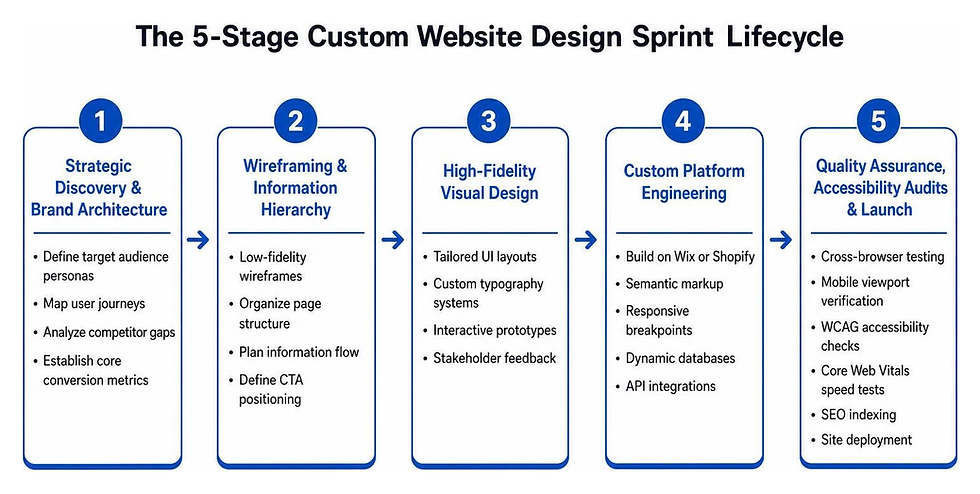
We follow a five-stage development sprint to deliver high-converting websites efficiently:
Strategic Discovery & Brand Architecture: We define your target audience personas, map user journeys, analyze competitor gaps, and establish core conversion metrics.
Wireframing & Information Hierarchy: Low-fidelity wireframes organize page structure, information flow, and CTA positioning before visual styling begins.
High-Fidelity Visual Design: We create tailored UI layouts, custom typography systems, and interactive prototypes for direct stakeholder feedback.
Custom Platform Engineering: Our developers build the site on Wix or Shopify, configuring semantic markup, responsive breakpoints, dynamic databases, and API integrations. Clear custom website design pricing keeps every project phase predictable.
Quality Assurance, Accessibility Audits & Launch: We perform cross-browser testing, mobile viewport verification, WCAG accessibility checks, Core Web Vitals speed tests, and foundational SEO indexing before site deployment.
Asset Ownership, Client Control, and Maintenance Costs
A major issue with generic site builders is platform lock-in, where businesses rent their digital footprint under restrictive terms.
With Quix Sites, you own your digital assets. Upon final project completion, full control of your domain, media assets, custom code, and CMS databases transfers entirely to your team.
Our custom Wix and Shopify builds empower non-technical staff to easily manage blog posts, add new e-commerce inventory, edit text, and review analytics without writing code or hiring developers for simple edits. When calculating the total cost of ownership over a 3-to-5 year window, a bespoke site built on an intuitive CMS eliminates expensive ongoing developer retainers, offering a high-ROI digital asset that scales alongside your business.
Frequently Asked Questions About Custom Web Design Services
How long does a custom website take to build from scratch?
While traditional design agencies often take 8 to 16 weeks to launch complex sites, our streamlined design process on Wix and Shopify enables rapid turnaround times. Standard custom brochure packages and tailored e-commerce builds are typically delivered in 3 to 10 business days, depending on page count and custom integrations.
Is custom web design affordable for small businesses on a budget?
Yes. Custom web design does not have to require enterprise-level capital. Investing in strategic website design for small business enables growing companies to launch with essential core pages first (Home, About, Services/Products, Contact) and scale features as revenue increases.
At Quix Sites, custom design packages start at $1,000, and hourly technical or graphic projects start at $150 per hour, providing accessible, high-performance web design for growing brands.
Can non-technical team members update site content independently?
Yes. We build every custom site on user-friendly visual CMS platforms (Wix or Shopify) with customized client dashboards. Non-technical team members can easily update copy, swap imagery, publish blog posts, and adjust e-commerce inventory in real time without touching code or risking layout breaks.
Conclusion: Transforming Your Digital Presence
Your website is the foundation of your online business. Settling for a generic, slow-loading template risks lost sales, poor search engine visibility, and diluted brand authority.
Investing in custom web design provides an agile digital asset engineered to engage visitors, pass Core Web Vitals, and scale with your business over the long haul.
Whether you are launching a new e-commerce venture on Shopify or scaling a service brand on Wix, Quix Sites delivers rapid, performance-driven web solutions tailored to your growth goals.
Explore our tailored custom website design solutions, claim complete control of your digital storefront, and turn your website into your strongest sales tool today.


