


Ecommerce Business Solutions That Actually Work
- 17 hours ago
- 9 min read
Why the Right Ecommerce Business Solutions Make or Break Your Online Store

Ecommerce business solutions are the tools, platforms, and systems that help you build, run, and grow an online store — and choosing the right ones directly impacts your sales, customer experience, and bottom line.
Here are the main types to know:
Solution Type | Best For | Examples |
SaaS / Hosted Platforms | Quick launch, small to mid-size stores | Shopify, Wix |
Headless / Composable | Enterprise scale, custom experiences | KIBO, commercetools |
All-in-One Platforms | Replacing multiple tools at once | bCommerce |
ERP + OMS Integration | Inventory, orders, accounting automation | Xentral |
Fulfillment / 3PL | Shipping, warehousing, last-mile delivery | Flexport, Stord |
AI Tools | Customer support, personalization, forecasting | eesel AI |
Running an online store in 2026 is not just about having a website. With global ecommerce sales projected to hit $8.1 trillion this year, the gap between stores that grow and stores that stall often comes down to one thing: the solutions stack powering them behind the scenes.
Whether you're just launching or trying to fix a store that isn't converting, this guide breaks down the solutions that actually move the needle — no fluff, no jargon.
I'm Athena Kavis, founder of Quix Sites, a Shopify and Wix Partner with over 8 years of web design experience and the personal background of having founded and sold two ecommerce business solutions-driven brands from scratch. I'll walk you through what works, what to skip, and what to look for at every stage of your ecommerce journey.

Core Types of Modern Ecommerce Business Solutions
When we talk about ecommerce business solutions, we aren't just talking about a shopping cart icon on a screen. Modern digital commerce is built on modularity, speed, and customization. Depending on your business size, operational complexity, and technical resources, your core architecture will generally fall into one of several distinct buckets.
Choosing the wrong foundational setup can trap you in a cycle of high maintenance costs and developmental bottlenecks. To design a store that actually scales, you must first understand the structural options available today.
SaaS and Hosted Platforms for Rapid Deployment
For the vast majority of growing businesses, Software-as-a-Service (SaaS) and hosted platforms are the gold standard. These platforms provide everything you need to get up and running out of the box: hosting, security, payment processing, and a visual store builder.
By utilizing leading SaaS giants like Shopify and Wix, you eliminate the headaches of server maintenance, manual security patches, and complex database management. Our team at Quix Sites specializes in custom Shopify Store Development Company services and high-performance Wix designs because they offer an unbeatable balance of speed, security, and ease of use.
With a hosted platform, you can launch a beautifully branded storefront in a fraction of the time it takes to build a custom system. For businesses looking to scale without hiring a massive in-house IT department, SaaS platforms are easily the most efficient path forward. If you want to dive deeper into how these platforms can be customized to match your brand, check out our comprehensive guide on Ecommerce Website Design and Development Services.
Headless and Composable Architecture for Enterprise Scale
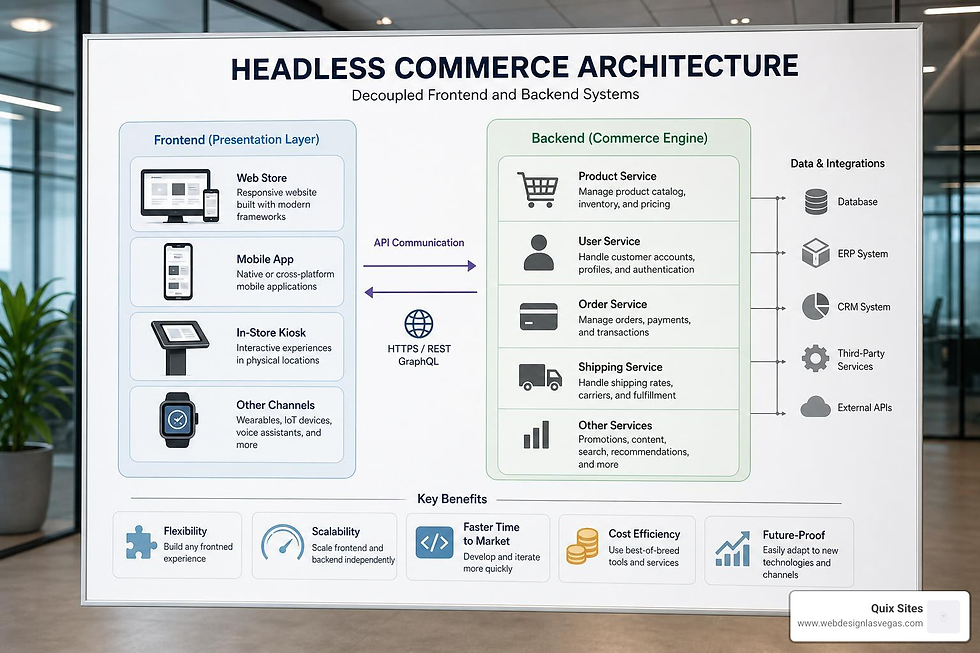
As businesses grow into mid-market and enterprise-level operations, their requirements often outgrow standard out-of-the-box setups. This is where headless commerce and composable architectures come into play.
In a traditional ecommerce setup, your front-end (what the customer sees) and your back-end (where the data, checkout, and inventory live) are tightly coupled. In a headless setup, they are completely separated. The front-end is built using modern web frameworks, while the back-end functions as an engine accessed via APIs.
This decoupling offers several major benefits:
Extreme Flexibility: You can deliver unique, hyper-personalized customer experiences on the front-end without risking back-end stability.
Developer Efficiency: Developers can work on the frontend design without disrupting core business databases.
Omnichannel Agility: You can push product catalog data to smart watches, custom mobile apps, in-store digital kiosks, or IoT devices easily.
By utilizing microservices, enterprise brands can deploy a Composable, Headless B2C & B2B Commerce Platform | KIBO to build a highly tailored digital roadmap. This modularity allows you to swap out individual components—such as your search engine, your promotions manager, or your checkout system—without the costly and risky process of replatforming your entire business.
Key Features to Evaluate in an Online Store Builder
Choosing an ecommerce platform is a major commitment. To ensure you invest in a system that supports long-term growth, you must look beyond aesthetic templates and evaluate the underlying features that keep your business running smoothly day-to-day.

Omnichannel Inventory and Multi-Channel Selling
Modern consumers don't just shop on your website. They browse on Instagram, buy on Amazon, ask questions on TikTok, and occasionally pick up their orders in person. If your inventory isn't perfectly synchronized across all of these touchpoints, you will inevitably end up overselling products, driving up customer support complaints, and hurting your brand reputation.
A robust online store builder must integrate seamlessly with your multi-channel sales strategy. This includes real-time synchronization with online marketplaces and social commerce engines. When evaluating solutions, look for platforms that offer built-in multi-warehouse tracking and direct integrations with advanced enterprise resource planning (ERP) systems.
For instance, utilizing Xentral ERP for e-commerce: Automate sales and scaling allows you to centralize your inventory across multiple warehouses, sales channels, and third-party logistics (3PL) providers, ensuring you maintain a single, accurate source of truth for your stock levels.
If you are a local business in the Henderson or Las Vegas valley looking to build a highly integrated physical-to-digital operation, partnering with a localized agency that understands regional supply chains is crucial. Working with a local expert can help bridge the gap between your physical operations and digital channels, ensuring your inventory and sales flow seamlessly.
Integrated Marketing, SEO, and Customer Retention Tools
A beautiful website is useless if nobody can find it. Your platform must be equipped with native marketing and SEO features that help you attract, convert, and retain high-value customers.
When reviewing potential platforms, verify that they support:
On-Page SEO Optimization: Customizable URL structures, editable meta tags, automatic sitemap generation, and fast-loading page speeds.
Built-in Marketing Automation: Automated abandoned cart recovery emails, SMS campaign triggers, and native discount engines.
Customer Retention & Loyalty Programs: Integrated reward systems, customized customer profiles, and subscription-based purchasing options.
For brands operating in competitive digital spaces, having a solid grasp of modern marketing workflows is essential. To maximize your search presence and build a site optimized for high conversion rates, take a look at our expert Ecommerce Web Agency Tips 2025.
If you are based in the local Vegas area and want to dominate regional search results, combining your platform's built-in tools with professional local SEO and digital marketing services can give you a massive competitive advantage.
Of course, custom design and marketing integrations come with varying investments. To plan your budget effectively, it helps to understand the typical Ecommerce Website Design Cost and how to choose an agency that fits your financial goals.
Streamlining Operations: ERP, Fulfillment, and AI Integrations
To scale an online business past the initial startup phase, you must transition from manual processes to automated workflows. A successful ecommerce business relies on a highly coordinated ecosystem of back-end systems that manage order processing, warehousing, shipping, and customer support.
Operational Area | Core Integration Type | Primary Business Benefit |
Inventory & ERP | Native API Connectors | Eliminates manual data entry, prevents overselling, and centralizes multi-warehouse stock levels. |
Fulfillment & 3PL | Automated Shipping Software | Lowers shipping rates, speeds up delivery times, and automates last-mile tracking. |
Customer Support | Conversational AI Agents | Resolves up to 73% of tier-1 requests instantly, handles order status inquiries, and recommends products. |
Unifying Operations with ERP and CRM Systems
As your order volume grows, relying on manual spreadsheets to sync your sales with your accounting and customer data becomes impossible. Unifying your storefront with a centralized Customer Relationship Management (CRM) tool and an ERP system is the only way to scale without operational chaos.
For businesses looking to simplify their entire tech stack, using an all-in-one operating system like bCommerce – Full-Stack eCommerce Platform can eliminate the need for dozens of expensive app subscriptions. By housing your storefront, CRM, shipping tools, and financial reporting under one roof, you reduce data silos and lower your monthly software overhead.
If you prefer a highly customized, modular approach, you can work with an agency to integrate your favorite standalone CRM and accounting platforms directly into your Wix or Shopify backend. For businesses looking for a broad-spectrum digital partner to manage these complex connections, partnering with an experienced agency like Quix Sites can help align your digital marketing, web development, and operational systems.
Optimizing Logistics with Advanced eCommerce Business Solutions
Fulfillment is the moment of truth in ecommerce. If your delivery is slow, expensive, or inaccurate, you will lose customers to competitors who offer seamless shipping experiences. Statistics show that offering reliable 2-day shipping can increase ecommerce conversion rates by an average of 32%.
To optimize your post-purchase experience, you need a logistics network that connects your digital store to physical fulfillment centers. Utilizing modern 3PL networks like eCommerce Fulfillment helps you distribute your inventory strategically across key distribution nodes, reducing shipping distances and lowering parcel costs.
For high-volume brands requiring a unified, end-to-end supply chain, implementing a Seamless Port-to-Porch Supply Chain Solution | Stord can yield massive operational savings. Brands leveraging integrated warehouse management systems have seen up to a 30% decrease in order picking times and a 75% reduction in packout times, while simultaneously saving 15% to 20% on last-mile parcel shipping.
If you are a Nevada-based business looking to optimize your regional logistics, you can partner with local warehousing solutions like E-Commerce Fulfillment Services for B2B and B2C to manage physical inventory storage, kitting, and rapid regional shipping.
Enhancing Customer Experience with AI-Driven eCommerce Business Solutions
Artificial intelligence has moved far beyond simple, frustrating chatbots. Today’s AI-driven ecommerce business solutions act as tireless, highly intelligent members of your customer service and sales teams.
By integrating a specialized AI E-commerce Agent - Sell More, Support Smarter | eesel AI, you can automatically sync your live store catalog, return policies, and shipping rules with a conversational assistant. These smart agents can:
Answer complex product questions in over 80 languages.
Provide real-time order tracking and handle return requests autonomously.
Recommend complementary products based on user context without being pushy.
By resolving up to 73% of tier-1 customer inquiries in the very first month, AI agents free up your human support team to focus on complex, high-touch customer relationships.
Frequently Asked Questions About Ecommerce Business Solutions
What is the difference between self-hosted and cloud-based ecommerce platforms?
Self-hosted platforms require you to download software and install it on your own web server. This gives you complete control over your code, but it also means you are entirely responsible for web hosting fees, server maintenance, security patches, PCI compliance, and manual software upgrades.
Cloud-based (SaaS) platforms, such as Shopify and Wix, are hosted by the platform provider. You pay a monthly subscription fee, and the provider handles all server maintenance, data security, hosting speed, and software updates. For the vast majority of scaling businesses, cloud-based platforms are the superior choice because they allow you to focus on selling products rather than managing technical infrastructure.
How do modern ecommerce platforms support B2B vs B2C models?
Historically, businesses had to run entirely separate websites for B2B and B2C operations. Modern ecommerce business solutions allow you to manage both models from a single unified backend.
For B2B customers, these platforms support advanced features like account-specific pricing tiers, self-service wholesale quotes, bulk-ordering tables, custom purchase orders (POs), and multi-user account hierarchies with built-in approval workflows. This hybrid capability ensures you can offer a seamless, consumer-grade shopping experience to retail buyers while respecting the complex purchasing agreements of your wholesale partners.
What are the hidden costs of running an ecommerce platform?
While a platform's base monthly subscription is easy to budget for, businesses must prepare for several additional costs:
Transaction Fees: Many platforms charge a percentage of your sales if you use external payment gateways.
App Add-Ons: Recurring monthly fees for specialized apps (such as subscription managers, advanced loyalty programs, or complex SEO tools).
Implementation & Customization: The upfront cost of hiring expert developers to design your store and integrate your back-end systems.
Bookkeeping & Compliance: Managing sales tax across multiple states and countries can be incredibly complex.
To keep your financials in order and avoid costly tax mistakes, we highly recommend working with a specialized local financial partner, such as a Henderson eCommerce Accountant, Taxes & Bookkeeping expert, to manage your digital sales taxes, bookkeeping, and operational overhead.
Conclusion
Building a successful online store isn't just about putting products online—it's about choosing the right ecommerce business solutions to power your growth, streamline your operations, and deliver an unforgettable experience to your customers.
At Quix Sites, we take the guesswork out of digital commerce. Based right here in Las Vegas, Nevada, we specialize in designing visually stunning, high-performance websites on Wix and Shopify. Whether you need a custom storefront design, professional branding and logo design, or advanced API integrations, we focus on rapid delivery and personalized branding to help your business stand out in the digital landscape.
Our pricing is transparent and built to fit your business stage, starting at $150 per hour for hourly projects and $1,000 for custom packages, with an efficient turnaround time of just 3 to 10 business days.
Ready to build an online store that actually works? Get a custom quote for your ecommerce project today, and let's turn your digital vision into a high-converting reality.


