Beyond Pretty Pixels: Crafting a Modern, High-Performance Website for Business Success
- Nov 9, 2025
- 10 min read
Why Your Website's Speed Defines Your Business Success

Fast loading website design is the foundation of a successful online business. Here's a quick overview of what's essential:
Key Elements of Fast Loading Website Design:
Optimize images - Compress files, use modern formats (WebP, AVIF), implement lazy loading
Streamline code - Minify CSS, JavaScript, and HTML; remove unused code
Leverage caching - Enable browser and server-side caching
Use a CDN - Distribute content globally for faster delivery
Choose reliable hosting - Fast server response times are critical
Reduce HTTP requests - Combine files, limit redirects, remove unnecessary plugins
Prioritize mobile - Design mobile-first for better performance across all devices
Target Speed: Under 3 seconds for general websites, under 2 seconds for e-commerce.
The numbers don't lie. A one-second load delay can cost you 7% of conversions. At three seconds, your bounce rate jumps by 32%. By the five-second mark, 90% of visitors are gone. This isn't about technical scores; it's about real money and real customers.
Your website is your 24/7 sales tool, but many businesses create beautiful sites that nobody waits around to see. Speed isn't just a technical detail; it's a business imperative. Since 2018, Google has used page speed as a ranking factor for mobile searches. With over 64% of internet traffic on mobile, a slow site is an invisible one.
Fortunately, a fast website doesn't mean sacrificing aesthetics. It means building smarter and understanding that performance is great design.
I'm Athena Kavis, and I've designed over 1,000 websites where speed was a core requirement. I've seen how it boosts conversions and revenue. In this guide, I'll show you how to build a site that's both visually stunning and blazingly fast, so you can stop losing customers to slow load times.

Why Speed is Non-Negotiable for Your Business Website
In today's digital landscape, user patience is scarce. A slow website hurts your brand perception, customer loyalty, and bottom line. For a potential client in Las Vegas, Henderson, or Pahrump, a site that crawls is a lost opportunity as they move on to the next Google result.
A slow website creates a negative first impression, suggesting your business is outdated or unprofessional. For our clients in Nevada, we ensure their online presence projects efficiency, and that starts with a fast loading website design.
The Direct Impact on User Experience and Bounce Rates
The link between speed and user experience is undeniable. Slow pages cause frustration, leading to higher bounce rates and shorter visits. Google's research is stark: increasing load time from one to three seconds raises the probability of a bounce by 32%. At five seconds, that probability hits 90%. With 40% of users abandoning a site that takes longer than three seconds to load, speed is critical for keeping potential customers in Centennial Hills or Vegas engaged.
Conversely, a fast site encourages users to stay longer and explore more. Sites loading in 5 seconds versus 19 seconds see 70% longer sessions and 35% lower bounce rates, leading to more engaged users and a better chance to make a lasting impression.
How Website Speed Influences SEO and Search Rankings
Beyond user happiness, fast loading website design is a critical SEO factor. Google has used page speed as a ranking signal for mobile searches since 2018. Because Google prioritizes user experience, a fast website is rewarded. As Google's John Mueller confirmed, "Speed is definitely a ranking factor."
A slow site can also harm your crawl budget. If Google's web crawler finds your site slow, it may crawl it less often, delaying the indexing of new content. This can make you less visible in search results, hurting your ability to reach customers in Las Vegas and beyond. Google's Core Web Vitals further cement speed's role in SEO by directly measuring user experience.
The Bottom Line: Connecting Speed to Conversions and Revenue
User experience and SEO impact your revenue. A slow website is expensive. A one-second delay in load time can cut conversions by 7%. If your site makes $100,000 a month, that's a $7,000 loss. For competitive markets like Las Vegas, this is significant.
The numbers are dramatic: a 2-second delay during a transaction can cause abandonment rates of up to 87%, while every 100ms improvement in load speed can lift conversions by over 1%. Real-world examples prove the ROI:
An apparel retailer boosted Black Friday revenue by 22% and conversions by 76% after a platform re-architecture.
An online retailer's focus on Core Web Vitals led to a 53% increase in revenue per visitor.
These cases show that investing in fast loading website design directly grows your bottom line. At Quix Sites, we view speed not as a luxury, but as a fundamental driver of business growth.
Measuring Your Need for Speed: Tools and Key Metrics
Before you can improve your website's speed, you need to measure its current performance. Solid data helps identify what's slowing you down and where to focus your efforts. You'll encounter two types of data: lab data (from simulated tests) and field data (from real users). While both are useful, field data shows how people in Las Vegas or Henderson actually experience your site.
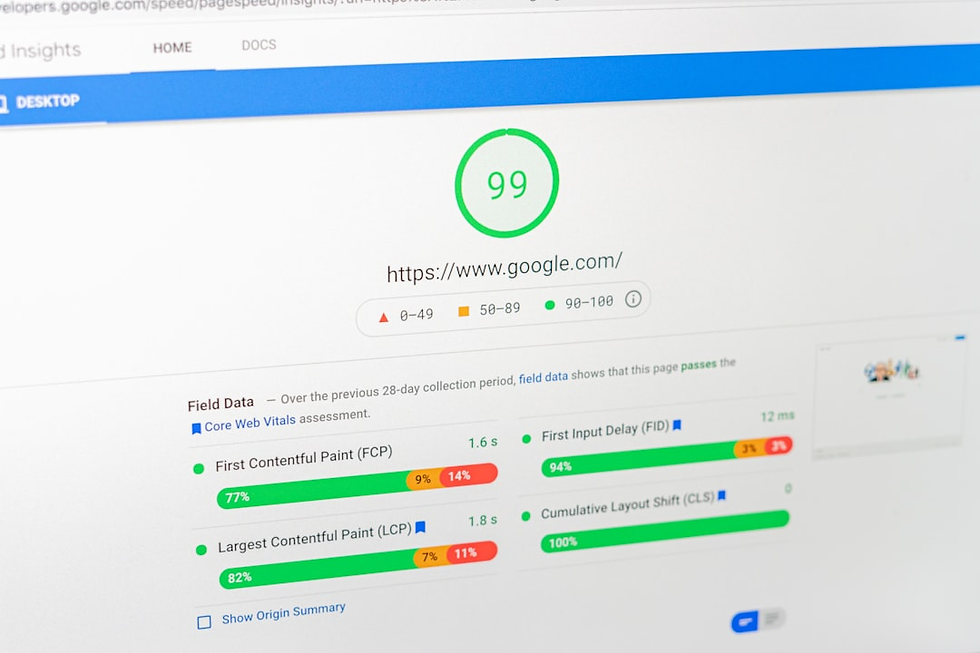
Essential Tools for Performance Analysis
Several powerful and free tools can give you a complete picture of your site's performance. At Quix Sites, we use these to ensure our clients' Wix and Shopify sites are running at peak speed.
Google PageSpeed Insights: Our first stop. It provides a 0-100 score for mobile and desktop, with specific, actionable recommendations from Google.
Google Lighthouse: Built into Chrome DevTools, it audits performance, accessibility, best practices, and SEO, giving immediate feedback on changes.
GTmetrix: Offers a detailed Waterfall chart showing how long each resource takes to load, making it easy to spot bottlenecks like large images or slow scripts.
Pingdom Website Speed Test: Allows testing from different global locations, which is useful for simulating local performance for a Las Vegas business.
WebPageTest: A more technical tool for deep analysis, testing from multiple locations with real browsers and connection speeds.
We use these tools to benchmark client sites and ensure we deliver the fast loading website design they deserve.
Understanding Core Web Vitals (CWV)
Google's Core Web Vitals (CWV) are key metrics for user experience and SEO. They measure what delights or frustrates visitors. When a site meets CWV thresholds, users are at least 24% less likely to abandon the page before it loads.
Largest Contentful Paint (LCP): Measures loading performance by tracking how quickly the main content (image or text) becomes visible. A good LCP is under 2.5 seconds.
Interaction to Next Paint (INP): Measures interactivity by tracking how quickly your site responds to user actions like clicks or taps. A good INP is 200 milliseconds or less. It replaced First Input Delay in March 2024 for a more complete view of responsiveness.
Cumulative Layout Shift (CLS): Measures visual stability, or how much unexpected content movement occurs during loading. A good CLS score is 0.1 or less.
At Quix Sites, we build every Wix and Shopify site with these Core Web Vitals in mind from the start. It's a core part of our fast loading website design philosophy, because a site that frustrates users isn't a good design, no matter how beautiful it is.
Core Strategies for Fast Loading Website Design
Now let's dive into the actionable strategies for creating a fast loading website design. These technical improvements make all the difference.

Optimizing Media: The Biggest Wins for Speed
Images and videos are often the main culprits for slow websites. Optimizing media delivers the biggest speed improvements with the least effort.
Image Compression: We compress images to reduce file size by up to 60% with no noticeable loss in quality, making pages load much faster.
Modern Image Formats: We use formats like WebP and AVIF, which can shrink file sizes by 25-70% compared to traditional JPEGs and PNGs, giving our clients' sites a serious speed advantage.
Lazy Loading: We only load images that are visible on the screen. As users scroll, more images load just in time, which is especially powerful for image-heavy pages.
Responsive Images: We serve images at the right size for each device. A phone user in Henderson doesn't need to download a massive desktop image, saving bandwidth and speeding up load times.
Video and Graphics: We compress videos for the web and replace large animated GIFs with faster-loading MP4 or WebM video files. For logos and icons, we use SVG format, which is small and stays crisp on any screen.
Streamlining Your Codebase for Efficiency
Your website's code (CSS, JavaScript, HTML) must be lean for a fast loading website design.
Minification: This process strips unnecessary characters (spaces, comments) from code files, making them smaller and faster to download.
Removing Unused Code: We hunt down and eliminate "dead code"—old CSS or JavaScript that is no longer used—to trim the fat from your site.
Asynchronous and Deferred Loading: We use async and defer attributes for JavaScript so scripts can load in the background or after the page has parsed, preventing them from blocking your content from appearing.
Reducing Render-Blocking Resources: We identify CSS and JavaScript files that block page rendering. By inlining critical CSS and deferring non-critical scripts, we ensure content appears quickly.
Enhancing Server and Network Performance
Even with optimized code and media, speed depends on your server and network.
Browser and Server-Side Caching: Browser caching stores files on a user's device for faster repeat visits. Server-side caching stores pre-generated versions of your pages to reduce server response time.
Content Delivery Network (CDN): A CDN copies your content to servers worldwide. A visitor from Las Vegas is served content from a nearby server, dramatically reducing latency and speeding up delivery.
Reducing HTTP Requests: Every element on your page requires a request. We reduce these by combining files and eliminating unnecessary elements.
Limiting Redirects: Unnecessary redirects add extra loading steps. We audit and remove them to ensure a direct path to your content.
Reliable Hosting: A slow server undermines all other optimizations. We recommend hosting with fast response times (under 200ms). Our clients at Quix Sites benefit from building on Wix and Shopify, which both offer excellent, performance-optimized hosting, providing a solid foundation from day one.
Advanced Design Principles for a High-Performance Website
Fast loading website design goes beyond technical fixes; it's about rethinking the design process itself. At Quix Sites, we bake performance into every decision, balancing form and function to create sites that are both visually stunning and lightning-fast.
The Mobile-First Approach to Fast Loading Website Design
With over 64% of internet users on phones, designing mobile-first is essential. This approach naturally creates a faster website for everyone. Starting with a small screen forces a focus on essential content, stripping away the bloat that slows down many sites.
At Quix Sites, we build every website with mobile responsiveness at its core. We prioritize key content so users in Las Vegas, Henderson, or Pahrump get what they need without waiting. Our fluid layouts and adaptive images ensure a seamless experience on any screen, saving bandwidth and improving performance across all devices. The result is one streamlined, efficient design that works beautifully everywhere.
Balancing Aesthetics and Speed with Lightweight UI/UX
Creating a beautiful website without sacrificing speed is an art we've mastered over 1,000+ high-performance Wix and Shopify sites. Our approach includes:
Smart Font Choices: We use system fonts where possible or ruthlessly optimize custom fonts with modern formats like WOFF2 to minimize their impact on load time.
Purposeful Animations: We avoid heavy, sluggish animations in favor of subtle CSS transitions that improve the user experience without hurting performance.
Minimalist Design: We focus on simple UI elements and a minimal DOM. Every element must serve a purpose. A clean, uncluttered design not only looks modern but also renders faster because the browser has less work to do.
Our custom website design services for Nevada businesses deliver this balance. Our Wix and Shopify sites are visually striking and load in under three seconds, proving you don't have to choose between beauty and speed.
Our custom packages start at $1,000, with hourly projects at $150 per hour, and we deliver in just 3-10 business days. We also offer comprehensive logo and branding services. If you're ready for a website that works as beautifully as it looks, get a quote for your project today.
Frequently Asked Questions about Website Speed
How fast should my website load?
Ideally, your website should load in under 3 seconds. Google research shows that as load time increases from one to three seconds, the probability of a user bouncing jumps by 32%. For e-commerce sites, the goal is even faster: under 2 seconds. Since the average page loads in about 3.21 seconds, beating that gives you a competitive edge.
At Quix Sites, we target these aggressive load times for all our fast loading website design projects in Las Vegas, Henderson, and Pahrump. Hitting the under-3-second mark on Wix and Shopify is non-negotiable.
Can a visually rich website with high-quality images and video still be fast?
Absolutely. The key is not to avoid rich media, but to optimize it intelligently. We build visually stunning websites that load incredibly fast by using modern image formats (WebP, AVIF), compressing files without quality loss, implementing lazy loading, and leveraging a Content Delivery Network (CDN).
A gorgeous, media-rich website can be a high-performance one with smart implementation. That's exactly what we deliver with our custom website design services.
What is the single most effective thing I can do to improve my site speed?
Optimizing your images is the quickest and most impactful change you can make. Large, uncompressed images are the number one cause of slow load times. A single 3MB hero image can tank your performance.
The fix is to compress images, resize them for their display dimensions, and serve them in modern formats like WebP. This simple step can often shave seconds off your load time. Your images will still look fantastic—they'll just appear much faster.
Conclusion: Build a Website That Works as Beautifully as It Looks
Website speed isn't just a technical detail; it's a fundamental feature that determines your online success. As we've seen, fast loading website design impacts everything from user engagement and SEO to your bottom line. A fast website isn't a luxury—it's the price of admission in today's digital marketplace.
At Quix Sites, we believe your website should turn heads and load in the blink of an eye. We specialize in creating visually stunning Wix and Shopify sites with lightning-fast performance baked into their DNA. For businesses in Las Vegas, Henderson, or Pahrump, a beautiful site that no one waits to see is just digital wallpaper. A beautiful site that loads instantly is a revenue-generating machine.
Our custom website design services combine performance optimization with eye-catching design. We also offer comprehensive logo and branding services to create a cohesive, professional digital presence.
Ready to stop losing customers to slow load times? Get a quote for your project today. Our custom packages start at $1,000, with hourly projects at $150 per hour, and we deliver in 3-10 business days.
For a head start, check out our ready-made Wix Templates for sale at https://www.webdesignlasvegas.com/shop, each built with our performance-first philosophy.
Your website should work as beautifully as it looks. Let's make that happen together.