Integrate Like a Pro: Mastering Shopify API Services
- Feb 6
- 14 min read
Beyond the Shopping Cart: The Power of Connected Commerce
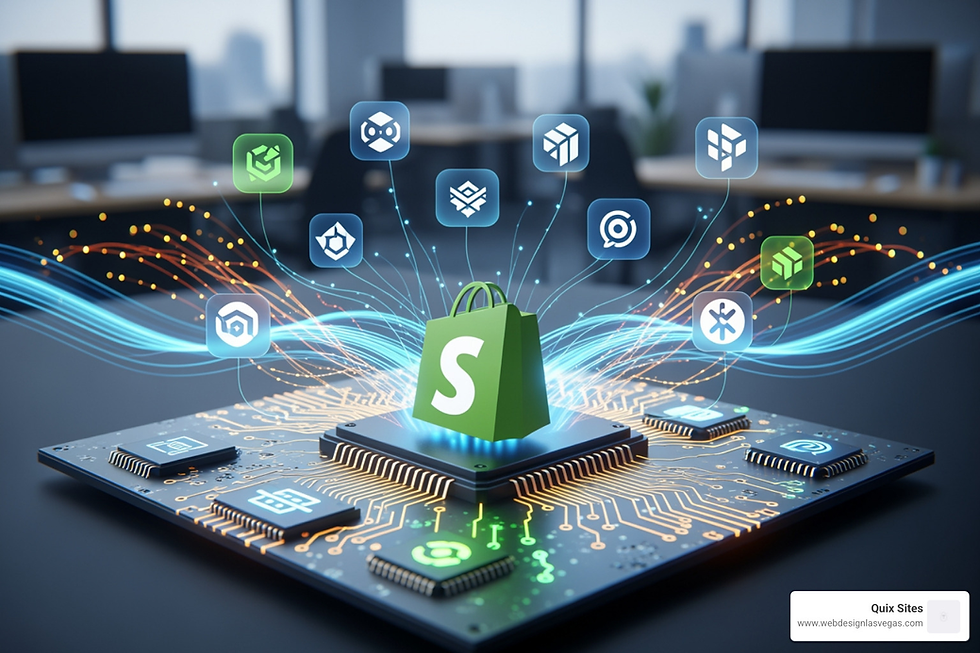
In today's competitive e-commerce landscape, a standalone online store is no longer enough. To truly thrive, businesses need a connected commerce ecosystem where every part of their operation—from inventory and marketing to customer service and accounting—works together seamlessly. This is where Shopify API integration services come in, acting as the digital glue that binds your various software tools into a single, powerful system.
By leveraging Shopify's robust Application Programming Interfaces (APIs), you can:
Automate Data Sync: Eliminate manual entry by connecting Shopify with your inventory, accounting, and customer management systems.
Streamline Multi-Channel Sales: Sync products and orders across platforms like Amazon, eBay, and social media.
Enable Real-Time Operations: Instantly update inventory, process orders, and track shipments across all systems.
Build Custom Functionality: Create unique features and workflows custom to your specific business needs.
Scale with Confidence: Handle increasing order volumes without a proportional increase in manual work.
With over 2.5 million active Shopify stores and global e-commerce sales projected to reach $6.86 trillion by 2025, operational efficiency is key. Many businesses struggle with disconnected systems, leading to manual data entry, errors, and wasted time.
An order comes in on Shopify, but your warehouse uses a different system. Your accounting software doesn't talk to your store. Your customer data is scattered across multiple platforms.
Shopify API integration services solve this by creating a unified ecosystem. When an order is placed, the system can automatically update inventory, notify your warehouse, send a confirmation email, and update your CRM—all in seconds.
At Quix Sites, we specialize in creating these powerful connections. As a Shopify Partner with over eight years of experience, we understand how to transform your e-commerce operations into a streamlined, automated powerhouse. Let's explore how.
The Shopify API Toolkit: Understanding Your Options

This section explains the core technologies that power Shopify integrations, from the different types of APIs to the modern shift in how data is requested. At Quix Sites, we understand that open uping your Shopify store's full potential often means connecting it to other vital business systems.
The magic behind these connections? Shopify's Application Programming Interfaces (APIs). Think of an API as a digital messenger that allows different software applications to talk to each other, sharing data and functionality seamlessly.
The Different Types of Shopify APIs
Shopify offers a rich ecosystem of APIs, each designed for specific purposes, giving developers incredible flexibility to extend and customize the platform. Here are the primary types we work with to build robust Shopify API integration services for our clients in Las Vegas, Henderson, and across Nevada:
Admin API: This is the powerhouse API for managing your Shopify store's backend data. It allows us to programmatically interact with almost every aspect of your store, from products and orders to customers, inventory, and fulfillment.
Storefront API: Designed for building custom shopping experiences, the Storefront API is perfect for headless commerce architectures. It lets us power bespoke websites, mobile apps, and other unique digital touchpoints, giving you complete control over your brand's frontend presentation while Shopify handles the backend commerce logic.
Webhooks: These are crucial for real-time data synchronization. Instead of constantly asking Shopify for updates, webhooks allow your systems to "listen" for specific events (like a new order, an inventory update, or a customer creation) and react instantly.
Customer Account API: A more recent addition, this API empowers us to build truly custom customer account experiences for headless stores. It allows us to manage customer data, authentication, and order history within your custom frontend.
Payments Apps API: For merchants with unique payment processing needs, this API allows us to create custom payment gateways and integrations, offering more flexibility in how your customers pay.
Shopify Function APIs: These APIs represent a significant leap in customization, allowing developers to extend or replace key parts of Shopify’s back-end logic with custom functions.
Through these APIs, we can access and manipulate key data points, including:
Products (details, variants, images, pricing)
Orders (status, line items, shipping, billing)
Customers (profiles, addresses, purchase history)
Inventory (stock levels, locations)
Technical Deep Dive: The Shift from REST to GraphQL
For years, the Shopify Admin API primarily relied on a REST (Representational State Transfer) API architecture. While effective, REST had certain limitations:
Over-fetching: Often, a REST endpoint would return more data than was actually needed, leading to larger response sizes and slower performance.
Under-fetching: Conversely, to get all necessary data for a complex view, multiple API requests were sometimes required, increasing latency and API call counts.
Shopify has made a significant shift towards its GraphQL API, especially for new integrations. GraphQL offers several compelling advantages:
Efficiency: With GraphQL, you can request exactly the data you need in a single query. This leads to smaller payloads and faster response times.
Reduced API Calls: Instead of making multiple REST requests to gather related data, a single GraphQL query can fetch all the necessary information, streamlining communication between your systems and Shopify.
Single Endpoint: GraphQL typically uses a single endpoint. Developers define the data structure they want within the query itself.
Flexibility: GraphQL provides a more flexible way to interact with your data, allowing for more dynamic and custom data retrieval.
This shift means that when we're building modern Shopify API integration services for you, we're leveraging efficient tools to help your connected systems perform optimally. You can explore Shopify's API documentation to learn more about these powerful tools.
Opening Up Potential: Common Use Cases for Shopify API Integration Services
Connecting your Shopify store to other essential business systems isn't just about technical prowess; it's about changing your operations into a powerful, centralized hub. Here at Quix Sites, serving businesses in Las Vegas and the surrounding areas, we've seen how strategic integrations can save countless hours, reduce errors, and free up teams to focus on growth.
Integrating with Core Business Systems
Imagine a world where your sales, inventory, customer data, and finances all live in perfect harmony. That's the promise of integrating Shopify with your core business systems:
ERP (Enterprise Resource Planning) Integration: For businesses managing complex operations, integrating with an ERP system like NetSuite or SAP connects your Shopify sales data directly to your financial records, inventory management, supply chain, and even manufacturing processes.
CRM (Customer Relationship Management) Integration: Integrating Shopify with your CRM (like Salesforce) means every customer interaction, purchase, and preference is captured in one place.
PIM (Product Information Management) Integration: A PIM integration ensures that detailed product descriptions, images, specifications, and pricing are centrally managed and automatically pushed to your Shopify store, as well as any other sales channels you operate.
Syncing Inventory: Shopify API integration services allow for real-time inventory synchronization between your Shopify store, your warehouse management system, and any other marketplaces or physical stores.
Automating Order Processing: From the moment a customer clicks "buy" to when the package leaves the warehouse, integration can automate every step.
Unifying Customer Data: By integrating Shopify with your CRM and other customer-facing tools, you create a single source of truth for all customer data.
Automating Sales, Marketing, and Fulfillment
Beyond core business systems, Shopify API integration services extend their benefits to your entire sales and marketing funnel, along with your fulfillment processes:
Multi-channel Sales: If you sell on your Shopify store and other platforms, we can sync products, inventory, and orders across your Shopify store and other sales channels.
Marketing Automation: Connect your Shopify store to your email marketing platform, SMS marketing tools, or social media advertising platforms. This enables automated campaigns based on customer behavior – think abandoned cart reminders or post-purchase follow-ups.
Shipping and 3PL Integration: Streamline your logistics by integrating Shopify with your preferred shipping carriers or third-party logistics (3PL) providers.
POS System Sync: For businesses with both online and physical stores in Las Vegas or Henderson, integrating your Shopify POS system is essential for a true omnichannel experience.
At Quix Sites, we specialize in crafting custom website design solutions that often include these powerful integrations, ensuring your online presence is not just beautiful but also highly functional and efficient. Learn more about how we approach custom website design.
The Blueprint for a Successful Integration
Building effective Shopify API integration services isn't just about connecting two pieces of software; it's about creating a robust, secure, and high-performing bridge that can handle the demands of your growing business. At Quix Sites, we approach every integration with a meticulous blueprint, ensuring long-term success for our clients in Las Vegas and beyond.
Core Requirements and Best Practices
To ensure your Shopify API integrations are solid, secure, and sustainable, we adhere to several core requirements and best practices:
Authentication (OAuth, Access Tokens): This is the gatekeeper of your data. All Shopify APIs require developers to authenticate. We use secure methods like OAuth to generate unique access tokens that grant specific permissions to your integrated applications. A crucial best practice is the "principle of least privilege," meaning an app only gets access to the data it absolutely needs.
API Rate Limits: Shopify has rate limits to prevent abuse and ensure fair usage. We design our integrations to respect these limits by using techniques like batching requests, implementing delays, and handling retry mechanisms.
API Versioning and Deprecation: Shopify's APIs are constantly evolving, with new features and improvements being rolled out regularly. This means APIs are versioned. We stay informed about API versioning, recent changes, and upcoming features to maintain compatibility and ensure smooth integrations. You can stay up-to-date with these changes by checking the Shopify changelog.
Scopes and Permissions: When an app requests access to your Shopify store, it asks for specific scopes or permissions (e.g., readproducts, writeorders). We ensure that our integrations only request the necessary permissions, enhancing security and adhering to Shopify's guidelines.
Data Security: Beyond authentication, we implement robust data security measures. All data exchange happens over secure HTTPS connections. For webhooks, we verify the HMAC signature to ensure that incoming requests are legitimate.
Performance Impact: Our goal is always to improve, not degrade, your store's performance. We achieve this through optimized code, asynchronous operations (running tasks in the background), and thorough testing.
Key Factors in a Shopify API Integration Services Strategy
Developing a successful Shopify API integration services strategy involves more than just technical execution; it requires foresight and a holistic view of your business needs:
Scalability Planning: We design solutions that can handle increasing volumes of data and traffic without breaking a sweat.
Error Handling: A robust integration includes comprehensive error handling mechanisms. This means logging errors, gracefully recovering from failures, and notifying the right people when intervention is needed.
Asynchronous Operations: For tasks that don't require immediate feedback (like updating inventory after a sale or syncing customer data), we leverage asynchronous processing.
Choosing the Right Data Sync Method (Webhooks vs. Polling): Webhooks are generally preferred for real-time updates due to their efficiency. However, for less time-sensitive data or when webhooks aren't available for a specific event, polling (periodically checking for updates) might be necessary.
Our portfolio showcases many successful projects where we've implemented these strategies to build high-performing, integrated Shopify stores. You can explore our work and see the difference a thoughtful approach makes by visiting our portfolio.
In-House vs. Professional Partner: Making the Right Choice
Deciding whether to tackle your Shopify API integration services internally or enlist the help of a professional agency is a pivotal business decision. It impacts not only your budget but also your time-to-market, the quality of your integration, and your ability to scale.
The Pros and Cons of DIY vs. Hiring an Agency
Feature | In-House Solution | Professional Service (e.g., Quix Sites) |
Cost | High, ongoing salary and overhead costs. | Project-based or hourly rates, often more cost-effective. |
Time-to-Market | Slower, due to learning curves and resource allocation. | Faster, leveraging existing expertise for quick turnarounds. |
Expertise | Limited to your team's knowledge. | Access to specialized, up-to-date Shopify API knowledge. |
Maintenance | Becomes an ongoing internal responsibility. | Often included or available as a dedicated service. |
Scalability | Can be difficult and expensive to scale. | Solutions are built with future growth in mind. |
Why Partner with Quix Sites?
For many businesses, partnering with a specialized agency like Quix Sites is an efficient and reliable path.
Expertise & Experience: As Shopify Partners, we have a deep understanding of the platform's APIs.
Speed & Efficiency: Our team can deliver robust integrations in a fraction of the time it would take to build an in-house solution from scratch.
Cost-Effective: With our project-based pricing and clear hourly rates, you get expert service without the long-term commitment of full-time hires.
Scalability & Support: We build solutions that grow with your business and offer ongoing maintenance to keep your systems running smoothly as Shopify evolves.
At Quix Sites, we specialize in creating high-performance Shopify stores with seamless integrations. Get a quote for your project and explore how our Shopify API integration services can support your business goals.
The Shopify API Toolkit: Understanding Your Options
Shopify's power lies in its Application Programming Interfaces (APIs), which allow different software systems to communicate and share data. At Quix Sites, we leverage these tools to build robust integrations for our clients in Las Vegas, Henderson, and across Nevada.
Key Shopify APIs
Shopify offers a suite of APIs for different purposes:
Admin API: The core for managing your store's backend data, including products, orders, and customers.
Storefront API: Enables custom, high-performance shopping experiences (headless commerce) on any platform.
Webhooks: Provides real-time notifications for events like new orders or inventory changes, enabling instant updates.
Customer Account API: Allows for the creation of unique, branded customer account pages.
Payments Apps API: Facilitates the integration of custom payment gateways.
Shopify Function APIs: Offers deep customization of Shopify's core logic for unique business needs.
These APIs provide access to crucial data points like products, orders, customers, and inventory, allowing for seamless integration.
The Shift to GraphQL
Shopify is transitioning from the traditional REST API to the more efficient GraphQL. This modern approach allows us to request only the specific data you need, reducing the number of API calls and improving performance.
For you, this means faster, more reliable, and more scalable integrations. As experts in this technology, we ensure your store leverages the best tools available. You can explore Shopify's official API documentation to learn more about these powerful tools.
Opening Up Potential: Common Use Cases for Shopify API Integration Services

Connecting your Shopify store to other business systems transforms your operations into a powerful, centralized hub. At Quix Sites, we help businesses in Las Vegas and the surrounding areas save countless hours and reduce errors through strategic integrations. Here are some common use cases:
Integrating with Core Business Systems
ERP (Enterprise Resource Planning) Integration: Connect Shopify with systems like NetSuite or SAP to sync sales data with your financial, inventory, and supply chain management. This ensures data consistency across your entire enterprise.
CRM (Customer Relationship Management) Integration: Integrate with your CRM (like Salesforce) to create a unified customer view. This empowers your sales and marketing teams with rich data for personalized campaigns and better customer service.
PIM (Product Information Management) Integration: Centralize your product information. A PIM integration ensures that product details, images, and pricing are consistent across your Shopify store and other sales channels.
Automating Sales, Marketing, and Fulfillment
Inventory & Order Management: Automatically sync inventory levels between your Shopify store, warehouse, and other sales channels (like Amazon and eBay) to prevent overselling. Streamline order processing by sending data directly to your fulfillment system for automated shipping and tracking updates.
Marketing Automation: Connect your Shopify store to marketing platforms like Mailchimp to trigger automated campaigns, such as abandoned cart reminders or personalized product recommendations, based on customer behavior.
Shipping and POS Integration: Integrate with shipping carriers for real-time rate calculations and label generation. For businesses with physical stores in Las Vegas or Henderson, syncing your Shopify POS system creates a seamless omnichannel experience for inventory and customer data.
At Quix Sites, we specialize in crafting custom website design solutions that often include these powerful integrations, ensuring your online presence is not just beautiful but also highly functional and efficient. Learn more about how we approach custom website design.
The Blueprint for a Successful Integration
A successful Shopify API integration requires more than just connecting two systems; it demands a strategic approach focused on security, performance, and scalability. At Quix Sites, we follow a proven blueprint to ensure your integrations are robust and future-proof.
Core Requirements and Best Practices
Authentication and Security: We use secure methods like OAuth and access tokens, adhering to the principle of least privilege to protect your data. All data is transmitted over encrypted HTTPS connections.
API Rate Limit Management: Shopify has API call limits to ensure platform stability. We design our integrations to work efficiently within these limits, preventing disruptions to your service.
API Versioning: Shopify's APIs evolve. We stay current with the latest versions and manage updates to ensure your integrations remain compatible and functional. You can track changes by checking the Shopify changelog.
Performance Impact: A poorly built integration can slow down your store. We use asynchronous operations and optimized code to ensure your store's performance is never compromised.
Key Strategic Considerations
Scalability Planning: We build solutions designed to grow with your business, handling increased data and traffic without a hitch.
Error Handling: Our integrations include robust error logging and recovery mechanisms to minimize downtime and quickly address any issues.
Choosing the Right Data Sync Method: We choose the right tool for the job, whether it's real-time updates with webhooks or scheduled data transfers (polling), to balance efficiency and your business needs.
Our portfolio showcases many successful projects where we've implemented these strategies to build high-performing, integrated Shopify stores. You can explore our work and see the difference a thoughtful approach makes by visiting our portfolio.
In-House vs. Professional Partner: Making the Right Choice
Deciding whether to build integrations in-house or hire a professional agency is a key business decision. It impacts your budget, timeline, and the quality of the final product.
Here’s a quick comparison:
Feature | In-House Solution | Professional Service (e.g., Quix Sites) |
Cost | High, ongoing salary and overhead costs. | Project-based or hourly rates, often more cost-effective. |
Time-to-Market | Slower, due to learning curves and resource allocation. | Faster, leveraging existing expertise for quick turnarounds. |
Expertise | Limited to your team's knowledge. | Access to specialized, up-to-date Shopify API knowledge. |
Maintenance | Becomes an ongoing internal responsibility. | Often included or available as a dedicated service. |
Scalability | Can be difficult and expensive to scale. | Solutions are built with future growth in mind. |
Why Partner with Quix Sites?
For most businesses, partnering with a specialized agency like Quix Sites is the most efficient and reliable path. Here’s why:
Expertise & Experience: As Shopify Partners, we have a deep understanding of the platform's APIs. We've built hundreds of custom solutions and know how to avoid common pitfalls, ensuring your project is done right the first time.
Speed & Efficiency: Our team can deliver robust integrations in a fraction of the time it would take to build an in-house team from scratch, often in just 3-10 business days.
Cost-Effective: Avoid the high overhead of full-time developers. With our project-based pricing (starting at $1,000) and clear hourly rates ($150/hr), you get expert service without the long-term commitment.
Scalability & Support: We build solutions that grow with your business and offer ongoing maintenance to keep your systems running smoothly as Shopify evolves.
At Quix Sites, we specialize in creating high-performance Shopify stores with seamless integrations. We're not just developers; we're partners in your success.
Ready to transform your Shopify store into a streamlined, automated powerhouse? Get a quote for your project and let's discuss how our Shopify API integration services can help you achieve your business goals.
Frequently Asked Questions about Shopify API Integrations
Here are answers to some common questions about Shopify API integration services.
How much does a Shopify integration cost?
The cost varies based on the complexity of the project, including the number of systems, data mapping requirements, and custom logic needed.
Basic Integrations: Often range from a few hundred to a few thousand dollars.
Complex Integrations (e.g., ERP): Can require a higher investment, depending on the scope and systems involved.
At Quix Sites, we provide detailed quotes custom to your specific needs.
How long does a Shopify integration take?
Timelines depend on the project's scope.
Simple Integrations: Can often be completed in a matter of days.
Intermediate and Complex Integrations: May take several weeks, particularly when multiple systems and custom logic are involved.
We outline clear timelines during the findy phase so you know what to expect.
Will a Shopify integration affect my store’s performance?
A professionally built integration should not slow down your store. We use best practices like asynchronous processing and optimized code to ensure integration tasks run in the background, without negatively impacting your customer's experience or your site's speed.
Conclusion: Build Your Connected Commerce Ecosystem
A well-executed integration strategy is the backbone of a modern, scalable e-commerce business, changing your Shopify store from a standalone sales channel into the central hub of your entire operation. By automating processes and unifying data, you empower your team to focus on growth, not manual data entry.
At Quix Sites, based in Las Vegas, NV, we're passionate about helping businesses like yours thrive online. Our expertise in Shopify web design, branding, and custom integrations means we don't just build websites; we build comprehensive digital solutions that drive success. From custom branding to high-performance web design, we ensure your online presence is both stunning and seamlessly integrated.
Ready to build a more efficient and powerful business? Schedule a consultation to discuss your custom Shopify integration needs. Let's make your Shopify store work smarter, not just harder.